Balatro Review: The Poker Roguelike That Ate 200 Hours of My Life
Balatro takes the familiar language of poker and twists it into one of the most addictive roguelikes in years. Here's why you won't be able to stop.
There’s a moment in every Balatro run where the numbers stop making sense. You play what looks like a garbage hand, a pair of 4s, and watch it cascade through your Jokers, multipliers, and enhancements until the score counter explodes past a million. You didn’t plan this. You didn’t expect it. But somewhere in the last 45 minutes, you built a machine, and now that machine is doing things its creator never imagined.
That feeling is why Balatro is one of the best roguelikes ever made.
What Is Balatro?
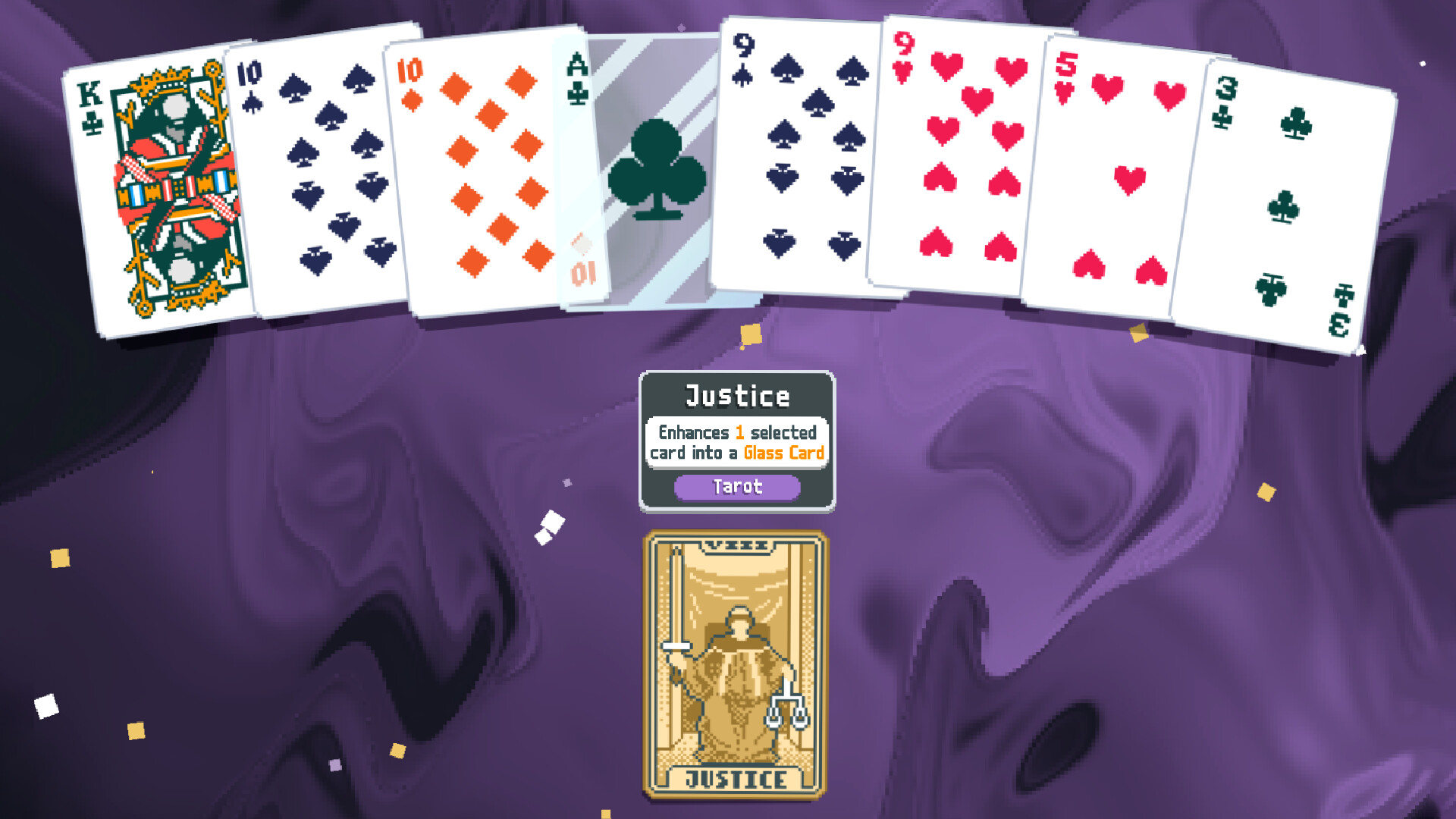
On paper, it sounds almost too simple. You play poker hands to score points. Beat the target score for each blind, advance through antes, and try to survive eight increasingly brutal rounds. Between rounds, you visit a shop where you can buy Jokers (passive modifiers), planet cards (hand level-ups), tarot cards (card enhancements), and special vouchers.
That’s it. That’s the whole game. And it is endlessly deep.
The Joker System Is Genius
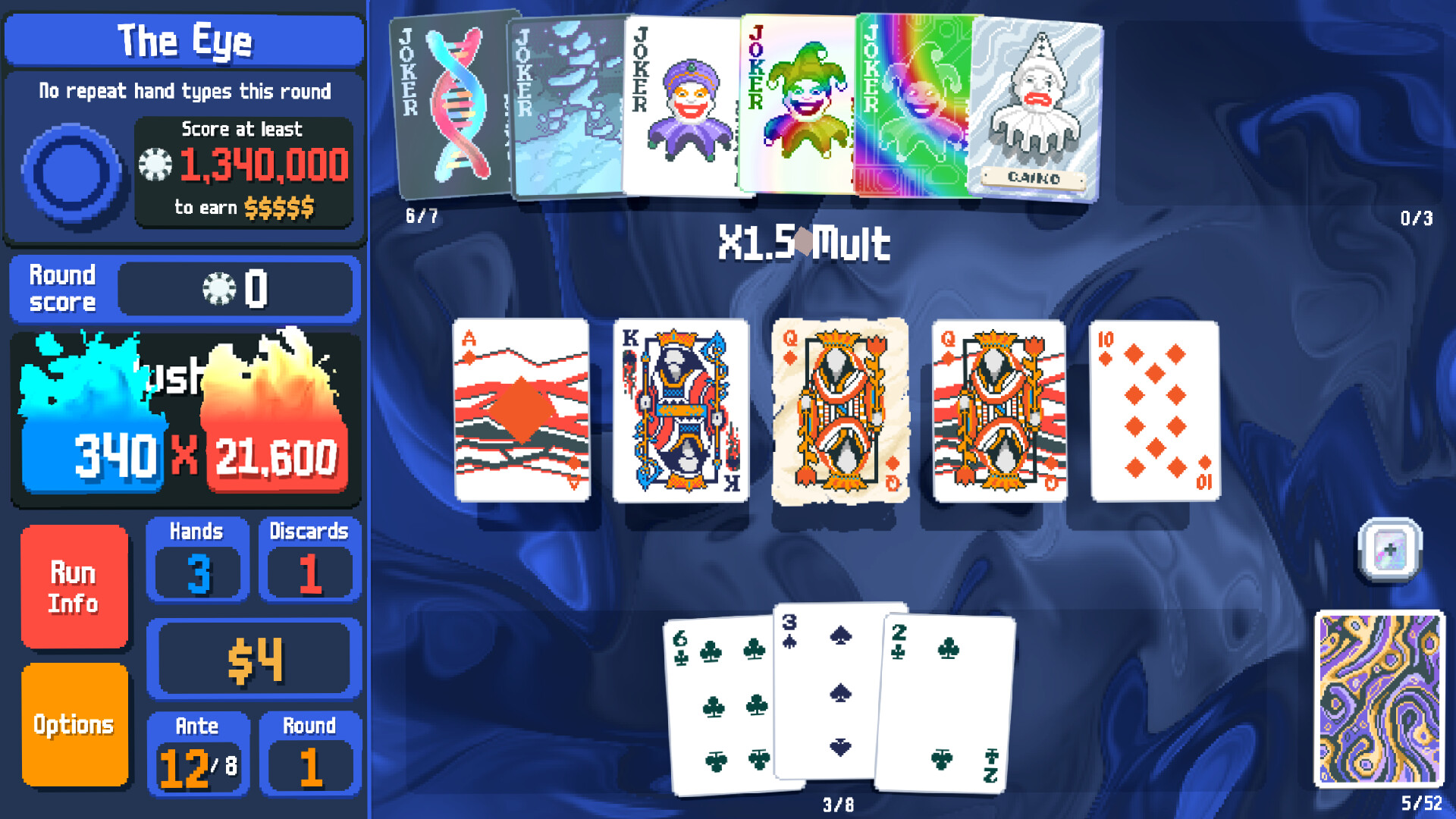
The heart of Balatro is the Joker system. You can hold up to five Jokers at a time, and each one modifies how your hands score. Some add flat chips. Some multiply your score. Some trigger conditionally: “if you play exactly 3 cards” or “if your hand contains a heart.” Some interact with each other in ways the developers clearly intended, and some interact in ways that feel like beautiful accidents.
The ordering of your Jokers matters. Multipliers apply left to right, so the same five Jokers in a different arrangement can produce wildly different scores. This creates a layer of optimization that’s invisible at first and consuming once you notice it.
By the midgame, you’re not thinking about poker anymore. You’re thinking about how to turn a Flush into a vehicle for your “multiply by number of face cards” Joker while your “retrigger all heart cards” Joker fires twice on your enhanced Kings. The poker hands are just the delivery mechanism. The Jokers are the game.
Difficulty That Respects Your Time
Balatro’s difficulty curve is one of the most elegant I’ve seen in a roguelike. The first few antes feel approachable. You’re learning the vocabulary, seeing what Jokers do, getting comfortable. By ante 5 or 6, the required scores start climbing steeply, and you realize your deck needs a coherent strategy or it’s going to fall apart.
Boss blinds add specific constraints: “all hearts are debuffed,” “you must play your hand face-down,” “the first hand played each round scores zero.” These force you to adapt or die, and they prevent any single strategy from feeling autopilot.
Critically, runs are fast. A full winning run takes 30-45 minutes. A loss might take 15. This means the sting of failure is brief and the pull to try again is immediate. “One more run” has never been more dangerous. If you are a game designer, our guide on what makes games addictive explains exactly why this loop length works so well.
The Presentation Is Immaculate
Balatro looks like nothing else. The CRT scanline filter, the psychedelic card animations, the way the score counter accelerates and slows. Every visual choice reinforces the feeling that you’re doing something illicit, like you’ve found a glitch in reality’s slot machine.
The sound design deserves special mention. Every chip scored makes a satisfying click. Multipliers have a heavier, more resonant sound. When a big combo chains together, the audio builds into a crescendo that makes a 50-million-point hand feel like an event. It’s casino psychology turned into art direction.
What It Does Better Than Slay the Spire
The inevitable comparison. Slay the Spire is the godfather of the roguelike deckbuilder (and its highly anticipated sequel heads to early access in March), and Balatro clearly learned from it: the shop structure, the boss mechanics, the run-based progression. But Balatro improves on the formula in a key way: every card in your deck matters.
In Slay the Spire, a large chunk of your starting deck is filler you’re trying to remove. In Balatro, even your lowest cards can be enhanced, multiplied, or leveraged by Jokers. You’re not trying to thin your deck. You’re trying to transform it. This means more decisions feel meaningful and fewer turns feel wasted.
The Endgame
After you beat the base game, the challenge stakes unlock. These are modifiers that stack on top of each other, culminating in the infamous “Gold Stake” difficulty where the game actively tries to destroy you. Blue seals, eternal Jokers, rental costs. It’s brutal, and it’s where the real mastery begins.
There are also hidden decks to unlock, secret Jokers to discover, and challenge runs that impose bizarre constraints. The content isn’t infinite, but I’m 200 hours in and still finding new synergies.
Who It’s Not For
If you hate randomness, Balatro will frustrate you. The shop offerings are random. Joker appearances are random. Sometimes you just don’t find the piece you need. Skilled players win more often, but no one wins every run, and some losses feel genuinely unfair.
If you need narrative motivation, you won’t find it here. There’s no story, no characters, no reason to keep playing except the pure mechanical satisfaction of building broken combos. For some people, that’s not enough.
The Bottom Line
Balatro is a masterclass in systems design. It takes a concept everyone understands, poker, and layers enough depth on top to sustain hundreds of hours. The presentation is distinctive, the difficulty curve is fair, the run length is perfect, and the Joker system is one of the best progression mechanics in any roguelike.
If you have even a passing interest in card games, roguelikes, or just well-designed systems, Balatro is essential. For another game that nails systems depth and replayability, check out Mewgenics, which just launched to similar critical acclaim. Just clear your schedule first.
Score: 9.5/10
Balatro is available on Steam for $14.99. A demo is available.

Written by
Stive Godin
Web dev by profession, gamer by passion. Always chasing the next great game and the next personal best in the gym. Building websites, playing games, and lifting heavy things.